
What if every flush in your home could help grow food — instead of wasting clean drinking water?
At Green Family Guide, we love South Africans who look at everyday problems and see brilliant, planet-friendly solutions. Meet Prof. Dyllon Randall, CEO and co-founder of Pee-Cycling. The Cape Town team turns human urine into clean, reusable water and nutrient-rich fertilizer for farms and gardens.
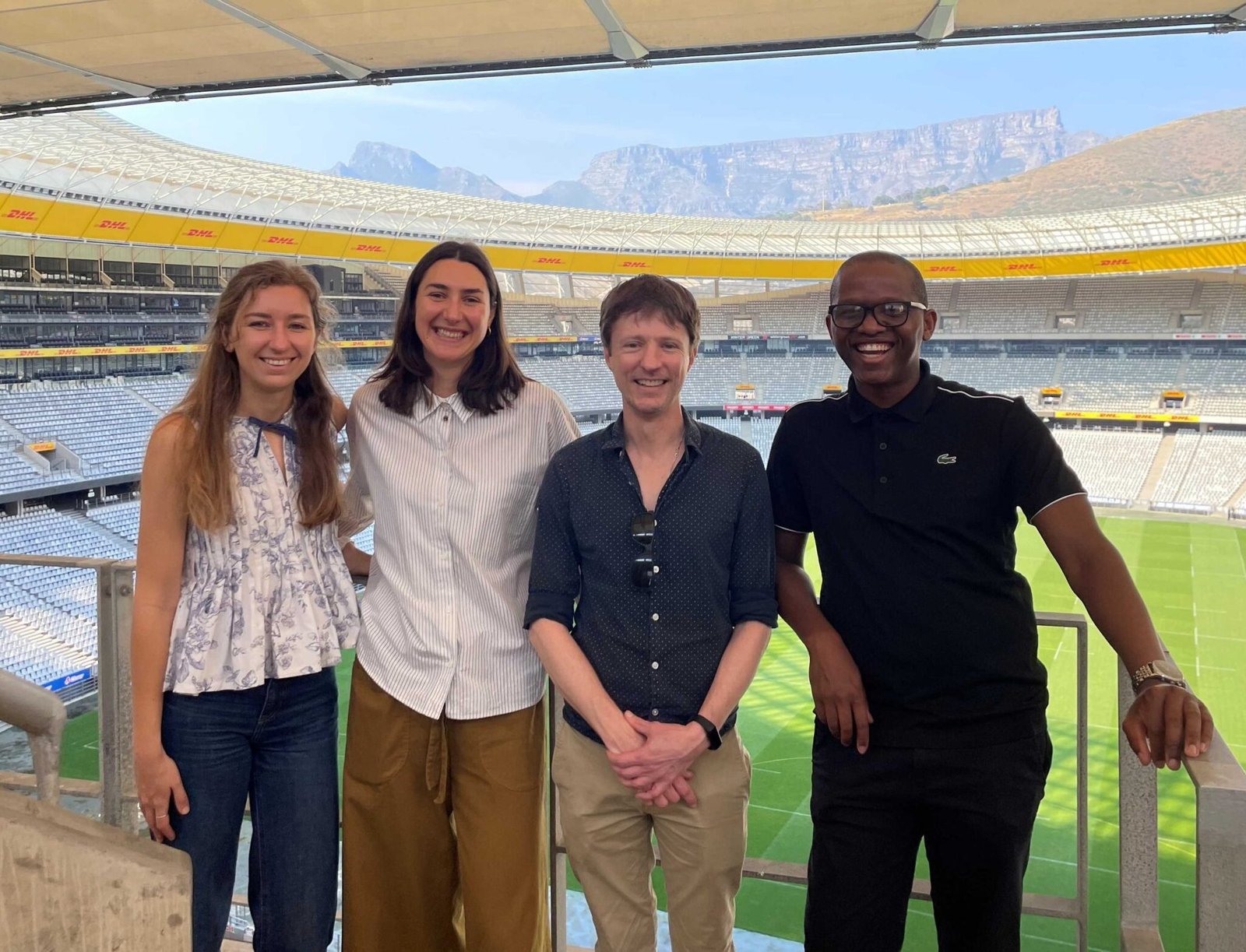
On 28 October 2026 in Johannesburg, Dyllon and his team were named runners-up at the Royal Academy of Engineering’s 2026 Africa Prize for Engineering Innovation. The team included Dr Caitlin Courtney, Anna Reid, and Njabulo Thela, and won £10,000 (around R222,000).
We quizzed Dyllon to find out how it works, what really happened at Cape Town Stadium, and what he would build with 1,000 acres.
1. Aha! Moment
What first inspired you to look at urine—an everyday waste product—and see a valuable resource? You saw its potential for agricultural fertilizer and water conservation.
My interest began while conducting research in Switzerland under the Reinvent the Toilet Challenge. There, I explored ways to recover fertilizer from human urine. When I returned to Cape Town in 2017, the city was facing its Day Zero water crisis.
It struck me that we were using precious drinking water to flush away something that was itself approximately 95% water. It also contained the major nutrients nitrogen, phosphorus and potassium—the same nutrients we need to make fertilizers. At the same time, we spend money and energy removing nitrogen and phosphorus at wastewater treatment plants. Then we import those same nutrients as synthetic fertilizers. It’s a messed-up system.
Our conventional sanitation systems treat urine as waste, although it could be a resource for agriculture. That contradiction inspired us to rethink sanitation. We see it not simply as a way to dispose of waste, but as an opportunity to recover water and nutrients.
Working with my co-founder, Dr Caitlin Courtney, we developed the research into what is now Pee-Cycling.
2. How It Works
For our readers who are new to the concept, how does the Pee-Cycling technology safely transform urine into nutrient-rich fertilizer while conserving drinking water?
Pee-Cycling is built around three stages: collection, stabilization and water removal.
1. Collect: Urine is collected separately through urinals or specially designed toilets. These keep it separate from other waste. 2. Stabilize: We stabilize it, which stops it from breaking down, losing nutrients, and getting smelly. 3. Remove Water: We remove the water using reverse osmosis, the same super-fine filter process used to desalinate seawater. Our special pretreatment step makes this possible.
The result? A concentrated, nutrient-rich liquid fertilizer AND a separate stream of treated water.
For every 1,000 liters of undiluted urine, we recover around 700 liters of water that can be reused for purposes such as toilet flushing, irrigation or cleaning.
Green Family Guide Note: That’s 300 litres of plant food + 700 litres of reusable water from every 1,000 litres. A massive win for water-stressed towns! The Royal Academy of Engineering confirms a full-scale unit can process up to 3,000 litres a day.
3. Real-World Impact
Seeing this technology operating at Cape Town Stadium is a huge milestone! What have been the most rewarding outcomes or insights from implementing it in such a major public venue?
One of the most exciting outcomes has been seeing just how much potential there is to recover resources from a single public bathroom.
During two major rugby matches at DHL Stadium, we collected 2,700 liters and 3,600 liters of urine, respectively. We used just one urinal trough. That demonstrated the enormous opportunity to scale collection across large public venues. Interestingly, the volume of urine collected does not correlate with the size of the crowd attending.
The stadium project has also been an important step in taking our research out of the laboratory. Bidvest Prestige supported the project, which operates in a real-world environment.
For us, the significance goes beyond the volumes collected. It demonstrates that existing buildings and facilities can support a circular economy. In this system, people recover resources rather than discard them.
Green Family Guide Note: A single full-scale Pee-Cycling unit can process up to 3,000 litres of urine a day. This proves that schools, shopping centres, and stadiums can all become mini resource-recovery hubs.
4. Shifting Mindsets
Waste-to-resource innovations often face cultural or psychological hesitations. How do you and your team work to break down barriers and change public perception around nutrient recovery?
An important part of changing perceptions is helping people understand the science and the value of what we currently call waste.
Because it is urine, we must work extra hard to make sure our product is safe, just as plants that treat wastewater to drinking water standards must. That means we need a strong scientific basis for everything we do. We must also be open about how the process works.
The beauty of chemistry is that a nutrient such as nitrogen or phosphorus is exactly the same whether it is made synthetically, mined, or recovered from urine. Its source does not matter to the growing plant, but it does matter to our planet. Recovering it from urine does not harm the environment. Once most people understand that, they are very supportive.
We have also seen exciting public curiosity. After early media coverage of our fertilizer-producing urinals and urine bio-brick at UCT, people began visiting the building specifically to use them. They liked the idea that something normally discarded could contribute to a useful product.
Education is something I feel very strongly about. People are usually against something simply because they have not learned about its potential. By explaining openly how the process works, we can break down taboos. We can also challenge century-old ways of thinking about sanitation.
5. The Road Ahead
Congratulations on being a finalist in the Africa Prize for Engineering Innovation! How has this journey shaped your future roadmap? How will you scale Pee-Cycling across South Africa and the continent?
The Africa Prize represents an important opportunity to take Pee-Cycling from university research towards a scalable commercial business.
We have spent almost a decade developing the science and engineering behind the technology. The next challenge is building the business around it. We must establish partnerships and demonstrate how it can work commercially.
The Prize provides business and leadership mentorship, training and access to networks that can support that transition.
Our longer-term vision is for buildings and urban infrastructure to become local centers for nutrient and water recovery. They would produce valuable resources rather than simply dispose of waste.
The opportunity is particularly relevant across Africa. Scholars predict that by 2050, one in four people on Earth will be African, and Africa’s cities will be home to an extra 700 million people. This means close to 70% of the infrastructure we will need has not been built yet. That is an exciting, once-in-a-lifetime opportunity to reshape how we deal with sanitation and urine. Rather than copying systems that flush water and nutrients away, we can choose a different approach.
Green Family Guide Note: The Royal Academy of Engineering delivers the Africa Prize, with part-funding from the UK’s International Science Partnerships Fund. The prize gives homegrown innovators the business mentorship and networks needed to turn brilliant lab ideas into everyday African solutions.
6. Resilient Cities
Regions face acute water security challenges. How significant a role can nutrient recovery and water-saving technologies play in building resilient urban ecosystems?
I believe these technologies are essential. Our planet and our future depend on them.
Scientists have identified planetary boundaries: safe limits for Earth’s natural systems. Our use of nitrogen and phosphorus has pushed us further beyond a safe limit than climate change has.
It is also a matter of food security. Up to 40% of the world’s traded urea, the most widely used nitrogen fertilizer, is shipped from the Middle East. This year’s disruptions in the Strait of Hormuz caused prices to more than double. About 70% of the world’s phosphate rock reserves are in a single country. That is why the United States added phosphate to its list of critical minerals last year, recognizing its importance to national security. Countries such as Germany and Switzerland now require phosphorus to be recovered from wastewater rather than simply removed.
Then there is water. Climate change is bringing increasing water shortages. These shortages will only get worse. We cannot continue flushing our waste away with drinking water.
The opportunity is to design cities whose infrastructure doesn’t simply consume resources, but actively recovers them.
7. Daily Eco-Habits
Outside of your engineering and research work, what is one simple, eco-conscious habit or swap you practice? How do you use it in your daily routine?
Having lived through Cape Town’s Day Zero drought, I cannot take long showers and I don’t take baths. When you live through that kind of crisis, the value of water really becomes apparent.
Try This At Home: Swap a bath for a 2–3 minute shower. Save 60–120 litres each time. Make it a family challenge this week: who can have the shortest shower with a favourite song playing? More ideas in our Top Tips – How to Walk Your Green Talk.
8. Where You Find Peace
When you need to step back, recharge, and find inspiration away from the lab and innovation space, where do you go? What is your favorite place in nature to restore your energy?
A walk in Newlands Forest in Cape Town. It has become a ritual, and often my best ideas come from those peaceful walks in the forest.
9. The 1,000-Acre Dream
If you were gifted 1,000 acres of land, what would you cultivate, design, or build there? You could create a sustainable ecosystem or community demonstration center.
I would build eco-houses designed around source separation. Urine would become fertilizer, feces would be composted, rainwater would be harvested, and greywater would be treated through a constructed wetland. The buildings would use locally sourced materials. Also, everything would follow a permaculture design approach, including a food forest.
Read more about growing your own food at home in our Family Health & Wellness section.
10. Advice for Future Changemakers
What advice would you share with young African engineers and eco-entrepreneurs? How can they solve local environmental challenges with bold ideas?
My advice would be to remain curious and challenge conventional thinking. Focus on problems where engineering can make a meaningful difference in people’s lives.
Innovation is rarely a straightforward journey. Our work has taken almost a decade of research, experimentation, and technical problem-solving. We needed to understand and solve many challenges before bringing the technology into a real-world environment.
It’s also important to build strong partnerships and sustained relationships, and surround yourself with people who bring different skills and perspectives.
Africa has the engineering talent and creativity to develop solutions to some of the continent’s greatest challenges. Sometimes, the most valuable opportunities are found in resources we have overlooked or simply considered waste.
What Does This Mean For Your Family?
- More water saved: Every liter recovered is a liter we don’t have to flush away with drinking water. See our Simple Water-Wise & Greywater Habits for Your Family.
- Healthier soil, healthier food: Nutrients go back to farms instead of being lost down the drain. Try Growing Tomatoes With Kids to see it in action at home.
- Resilient cities: Our homes and schools could one day recycle water and nutrients right where they are made.
For the Kids: Think of urine like a juice box for plants. It’s about 95% water, plus the exact nutrients plants need to grow — nitrogen, phosphorus and potassium. Pee-Cycling just separates the water from the plant food!
Photo Caption: Dyllon Randall and the Pee-Cycling team at Cape Town Stadium. Pictured from left are Dr Caitlin Courtney (Chief Science Officer & Co-founder), Anna Reid (Chief Technology Officer), Prof. Dyllon Randall (CEO & Co-founder), and Njabulo Thela (Research & Development Lead).